
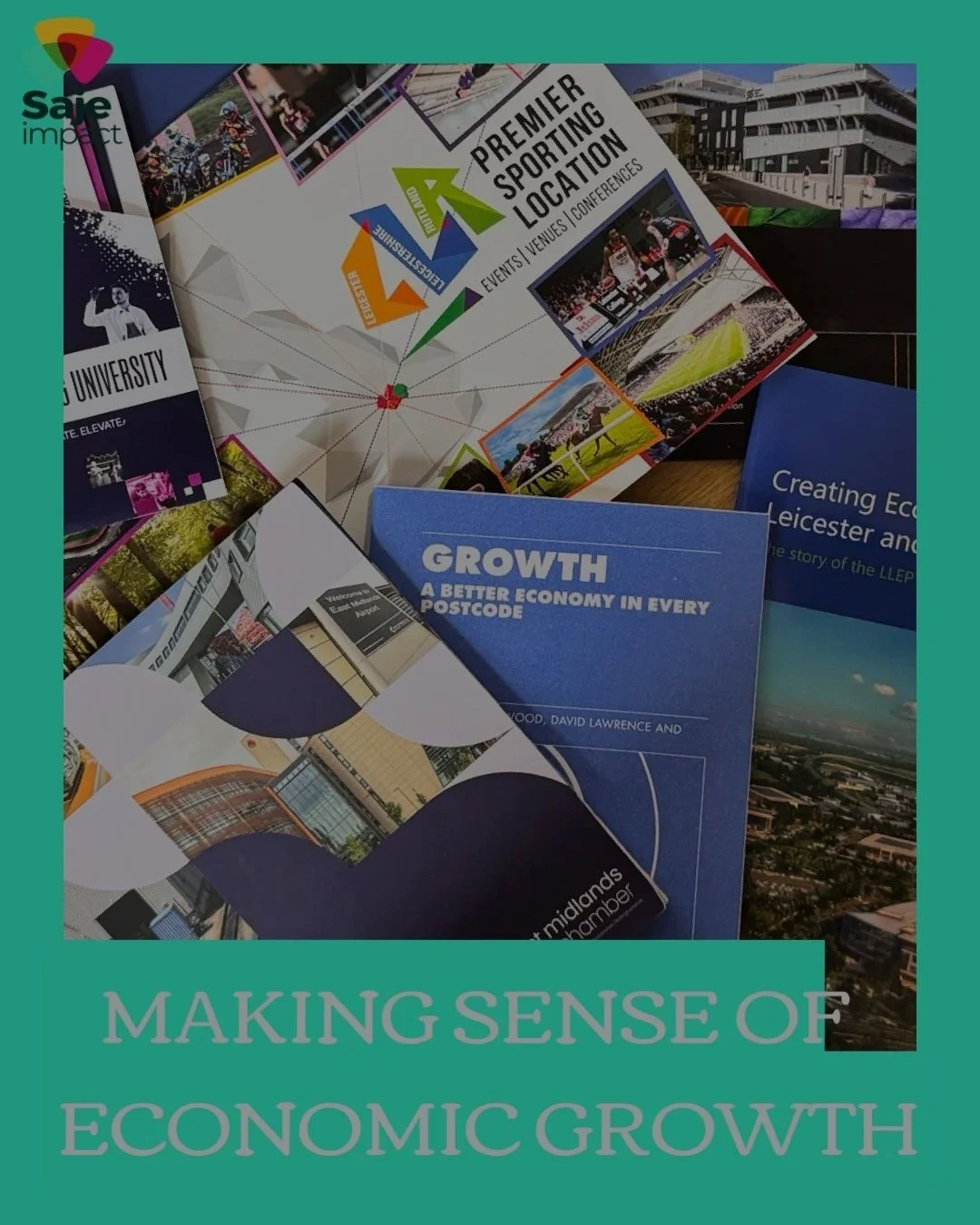
II've spent the last few days with a pile of economic development plans spread across my desk. There's the Local Industrial Strategy from 2019 and the LLEP's own story of 2011-24, the East Midlands Chamber's Framework for Growth and the Fabian pamphlet Growth: A Better Economy in Every Postcode. Then there are the prospectuses from our universities, the Space Park Leicester brochure, and the Leicester, Leicestershire and Rutland sporting offer.
Read together, they're a remarkable body of work. They're also a little humbling.
No shortage of ideas
The first thing that strikes you is how much we agree on. Whoever wrote them and whenever, the same strengths come up again and again: a world-class space and research cluster, two universities with real reach, a strong advanced manufacturing and logistics base, a distinctive sporting and events offer, and a young, diverse and entrepreneurial population. The same challenges come up too: skills gaps, uneven productivity, transport and connectivity, and pockets of deprivation sitting close to areas of real prosperity.
Leicester, Leicestershire and Rutland (LLR) has never lacked talent, ambition or good ideas. If planning alone delivered growth, we'd be one of the most successful places in the country.
The missing ingredients
What the pile also shows is what's been absent. I'd put it down to three things.
Long-term funding. Too much of our economic development has been done through short funding rounds and competitive bidding. We write a bid, wait, win or lose, and start again. Projects get shaped around what a funding pot allows rather than what the place needs. A strategy is only as good as the money that sits behind it over ten or fifteen years, not twelve months.
A consistent vision. Plans change with governments, funding regimes and institutions. The LLEP, the Local Industrial Strategy and the various growth deals each made sense in their moment, but each also reset the conversation. Businesses and investors want to know where a place is heading and that it will still be heading there when the political weather changes.
Action across the whole of LLR. We are one functional economy. People live in one place, work in another and shop in a third. Supply chains don't stop at the city boundary or the county line. Yet our decision-making has too often followed administrative geography rather than economic reality. The result is duplication, missed opportunities and a weaker voice when we make our case to Whitehall.
Why devolution matters now
This is why I think the devolution conversation now under way for Leicestershire is so important, and why I've been looking back before looking forward.
We have been here before. Previous attempts to secure a deal for the area didn't get over the line, and meanwhile our neighbours in Derbyshire and Nottinghamshire moved ahead with the East Midlands Combined County Authority, with its own mayor, its own funding settlement and its own seat at the table. I don't say that in a spirit of grievance. It simply means that for the last few years others have had powers and long-term funding that we haven't.
The direction of travel from government is clear. Devolution is being tied closely to local government reorganisation, and strategic authorities led by a mayor are the model on offer. Our local councils have been working through what that means for LLR, and there is a lively debate about how best to structure it. That debate matters, but I'd argue that the prize at the end of it matters more.
What a combined authority and mayor could actually do
Devolution can feel abstract, so let me try to make it concrete. In broad terms, a mayoral combined authority is a body that brings together the councils in an area so that big strategic decisions can be taken once, for the whole area, with real money and real powers behind them. Elsewhere in England, those have included:
• Long-term, flexible funding. Rather than endless bidding rounds, an "investment fund" or consolidated settlement over a number of years, so we can plan and commit with confidence.
• Transport and infrastructure. Joined-up planning for buses, rail, highways and active travel across the whole area, and a stronger hand in major projects.
• Skills and employment. Control over adult education budgets and a closer match between what employers need and what colleges and training providers deliver.
• Strategic planning, housing and regeneration. A single view of where homes, jobs and employment land should go, supported by the tools to make it happen.
• Business support and inward investment. One clear voice and one clear offer to the world, instead of several competing ones.
• A single point of accountability. An elected mayor who can speak for the whole of LLR, be held to account for delivery, and sit alongside other regional leaders in talking to government.
None of this works by magic. A mayor and a combined authority don't create growth on their own. What they can do is give us the stability, scale and authority to turn good plans into delivery, and to keep going when the political cycle turns.
Learning from what's gone before
That's why I'm not interested in simply throwing the old plans away. The best of them contain real insight, and some delivered real results. The Space Park, the growth of our universities, the work to establish LLR as a sporting destination: none of that happened by accident, and much of it was the product of people working across boundaries.
The honest question is what held us back from doing more, and what would be different with a devolved settlement. That's what I want to explore properly in the coming weeks.
What's coming next
Over the next few weeks I'll be writing more on three themes:
Looking back. What past plans got right, what they got wrong, and what we should carry forward.
What a combined authority and mayor could mean. The powers, the funding, how they work elsewhere, and what they would and wouldn't change for people and businesses in LLR.
Our key sectors. A sector-by-sector look at what devolution could mean for the industries that matter most to our economy, from advanced manufacturing and space to logistics, higher education, health, creative industries, and sport and physical activity.
Over to you
I'd really like to hear from you as I do this. If you run a business, work in a university or college, lead a community organisation, sit on a council or simply care about where Leicestershire is heading, tell me:
• Which plan or initiative do you think has made the biggest difference locally?
• Where have we let good ideas fall through the cracks?
• What would you want a devolved LLR to prioritise first?
The pile on my desk is evidence that we know what we want to achieve. The task now is making sure we have the tools, the funding and the consistency to do it.
Andy Reed OBE chairs the Business Board for the Leicestershire councils.