
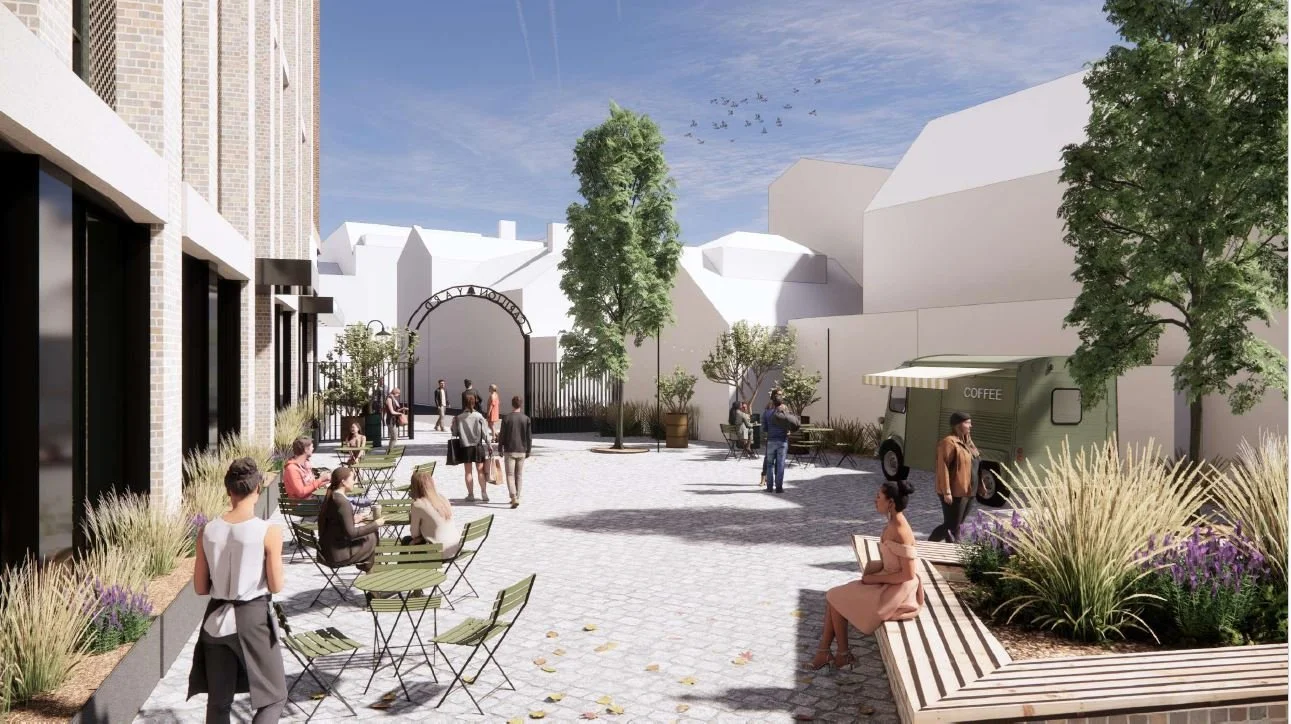
There is a lot of emotion around town centre change, and that is understandable. Places like Carillon Court are tied up with memory, habit and a sense of what the town used to be. But nostalgia can only take us so far. If we want Loughborough’s town centre to have a future, we have to look honestly at the conditions that exist now, not the ones people remember from 20 or 30 years ago.
The first thing to recognise is that regeneration has to make commercial sense. That is not a slogan, it is the basic test of whether anything will actually happen. It is easy to say that old shops should stay open, or that a new leisure use would be nice, or that the centre should somehow return to a past version of itself. But if those uses are not viable, or if no business can be found to occupy them, then simply preserving them does not create renewal. It creates delay, decline and uncertainty. Town centres cannot be held together by sentiment alone.
That is why so much of modern regeneration focuses on mixed use. A town centre scheme needs more than one source of value and more than one reason for people to visit. Retail on its own is weaker than it used to be because shopping habits have changed permanently. People buy more online, compare prices instantly, and expect convenience. That does not mean physical shopping is dead. It means the high street has to offer something broader and better than it once did. It must combine shops with cafés, leisure, business space, homes, culture and public realm that make people want to spend time there.
Some people online present this as if councils or planners have simply chosen to “get rid of retail.” That is too simplistic. The reality is that many older retail blocks are already struggling because the market has changed. Carillon Court is a private asset, not a public one, and it was sold because the old model had stopped working properly. That is not a council failure or a government plot. It is part of a much wider economic shift affecting town centres everywhere. The question now is not whether that change exists, because it clearly does. The question is whether Loughborough adapts well or slowly drifts backwards.
That is where the case for student and professional accommodation becomes important. Far from being a negative, homes in the town centre can be one of the strongest tools for keeping a place alive. Residents create constant activity. They support local shops, cafés and services. They generate footfall in the morning, daytime and evening, which is exactly what most town centres need. A centre with people in it feels safer, more confident and more attractive than one that goes quiet after trading hours. People talk about “eyes on the street” for a reason: places are more welcoming when they are lived in.
There is also a broader housing logic. Loughborough already has more student accommodation being created on campus, so some town-centre provision can help distribute demand more sensibly. It can reduce pressure on older terraced housing stock that was not designed to absorb endless expansion. It can also make better use of central land that is already connected to transport, shops, services and amenities. In planning terms, that is much more sustainable than pushing everything to the edge of town.
Then there is the point about opening up links and improving permeability. This may sound technical, but it is actually one of the most important parts of the whole vision. If a building or site acts like a wall, it cuts the town in half. If it opens up routes, people move through it. That movement creates life. It helps businesses. It makes the town easier to navigate. It allows a centre to feel like a connected place rather than a collection of disconnected blocks. In a place like Loughborough, opening up those links is not just a nice design idea — it is a practical step toward a stronger centre.
This is also why some of the more nostalgic arguments miss the point. Wanting familiar shops back is understandable, but wishing for old retail units to reopen is not a strategy. Hoping a large leisure operator will appear because we would like one to is not a strategy either. Regeneration has to start with what is realistic, viable and deliverable. That means accepting that the future mix may look different from the past. It may include less traditional retail and more homes, more flexible space, more leisure, more cultural activity and better public realm. That is not loss for its own sake. It is adaptation.
And adaptation matters because the alternative is stagnation. An ageing shopping block with declining demand, poor connectivity and limited appeal does not magically recover simply because people would prefer it to. Time moves on. Town centres must move with it. The aim is not to erase the past, but to build on the town’s strengths in a way that reflects current reality.
So the positive case is this: a better mixed-use Carillon Court can help create more footfall, more safety, more activity, more homes, more investment and a more resilient town centre. It can support local trade instead of depending on old models that no longer work. It can bring life into the centre rather than leaving it tied to underused retail space. And it can do all of that while helping Loughborough remain a place people want to visit, work in, study in and live in.
This is whay I have decided we need to be honest with people about what is realistic and possible and not to be afraid to set this out for fear of the online mob. If we hide from sharing the very difficult decisions we end up just being like the populists - pretending everyhting is easy and there are no trade-offs. We need to explain the realities.
That is the real argument for regeneration. Not nostalgia. Not denial. But a practical, confident future built on what towns need now.